
Why Men Don’t Approach Women Anymore: The Death of the Cold Approach
Men stopped approaching women in public - and it's not because they're scared. It's because the risk-reward ratio collapsed. Here's what changed.

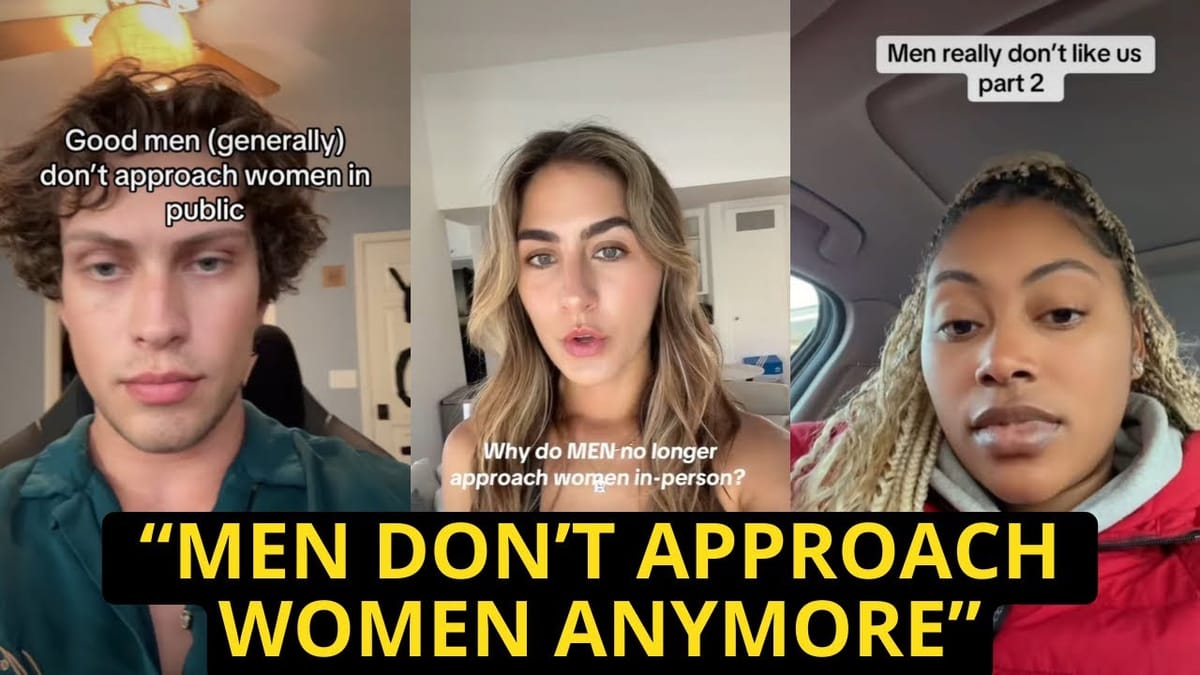
Men stopped approaching women in public — and it’s not because they’re scared. It’s because the risk-reward ratio collapsed. Here’s what changed.
Why don’t men approach women anymore? It’s the question women whisper in group chats, therapists hear weekly, and dating coaches build entire businesses around. The cold approach — walking up to a stranger and shooting your shot — used to be how most relationships started. Now it’s practically extinct.
And men aren’t apologizing for killing it.
63% of men under 30 are single according to Pew Research. But here’s the part that should alarm everyone: the share of single men actively pursuing relationships has dropped since 2019. They’re not failing to approach. They’re choosing not to.
The question isn’t why men lost confidence. It’s why the math stopped making sense.
When Did Men Stop Approaching Women?
The cold approach didn’t die overnight. It was a slow death by a thousand cuts — each one making the risk a little higher and the reward a little less certain.
The #MeToo recalibration. Let’s be clear: #MeToo was necessary. Predatory behavior needed consequences. But the cultural overcorrection created a chilling effect on all male initiation — not just the predatory kind. Men who would have confidently introduced themselves at a coffee shop in 2015 now hesitate because the line between “confident” and “creepy” became impossible to predict.
A 2023 study found that over 50% of men say they’re less likely to engage in everyday interactions with women — including compliments, conversations, and approaches — due to fear of being perceived as inappropriate.
That’s not cowardice. That’s risk management.
Social media surveillance. Every approach now carries the risk of becoming content. Women film unwanted approaches and post them for millions to mock. “This man really thought he could talk to me at Target” gets 500K views while the guy in the video gets identified, shamed, and potentially fired.
The cold approach used to be private. A rejection meant walking away and forgetting about it. Now a rejection can mean public humiliation with a permanent digital footprint.
Dating apps replaced the function. Why risk in-person rejection when you can swipe from your couch? Dating apps promised to eliminate the awkwardness of approaching — and they did. They also eliminated the spontaneity, the charm, and the human element that made organic connections meaningful. But for men calculating pure risk-reward, the app felt safer.
Until it wasn’t. Because as we’ve covered, dating apps deliver diminishing returns for 80% of men. So now they’re not approaching in person or succeeding on apps. The result? Mass withdrawal.
The Risk-Reward Calculation Men Are Making
Every man considering an approach runs an unconscious cost-benefit analysis. In 2026, that calculation looks like this:
Potential upside: A phone number, a date, maybe a relationship. Best case scenario — you meet someone great through a moment of courage.
Potential downside: Public rejection, being called a creep, getting filmed and posted online, being reported to management (if in a store or gym), HR involvement (if at work), social media shaming, or legal consequences if she interprets the approach as harassment.
The upside hasn’t changed in 50 years. The downside has expanded exponentially.
A man approaching a woman at a bar in 1995 risked a polite “no thanks.” A man approaching a woman at a gym in 2026 risks losing his membership. A man approaching a woman at work risks losing his career.
The rational response to asymmetric risk is avoidance. Men aren’t weak for calculating this. They’re intelligent.
What Women Say vs. What Women Do
Here’s the contradiction that drives the entire conversation:
What women say: “I wish men would approach me in real life instead of hiding behind apps.” “Where are all the confident men?” “I want a man who sees me across the room and just goes for it.”
What women do: Film men who approach them uninvited. Post “this creepy guy tried to talk to me” stories. Create TikToks mocking men who shot their shot. Tell men that approaching women in public is “harassment” unless the woman is already interested — which the man has no way of knowing without approaching.
The Hinge 2025 report found that 43% of Gen Z women wait for the man to initiate. But the same cultural moment has made initiation risky, stigmatized, and potentially career-ending.
Women want men to approach — but only the right men, at the right time, in the right way, with the right energy. And if he gets any of those variables wrong? He’s not a brave guy who took a chance. He’s a creep.
Men heard this message loud and clear. And they responded logically: if the rules are unknowable and the penalties are severe, the only winning move is not to play.
The Gym, the Coffee Shop, and the Office: Where Approaching Died
Let’s walk through the specific environments where the cold approach used to thrive — and why it’s now functionally dead in each.
The gym. Women have campaigned aggressively — and understandably — for the right to work out without being hit on. “Don’t talk to me at the gym” is practically a commandment. Gyms now post policies discouraging unsolicited conversations. The result? Men put in their headphones and pretend women don’t exist. Even the ones who would have been welcome to approach.
The coffee shop. The quintessential “meet-cute” location. But in the remote-work era, coffee shops are offices. Women with laptops and headphones are signaling “don’t bother me.” And the social media risk applies — one bad interaction and you’re the villain in someone’s Instagram story.
The workplace. Completely dead. Post-#MeToo workplace policies have made any romantic initiation a potential HR violation. Many companies explicitly prohibit asking coworkers on dates. The risk isn’t just rejection — it’s termination. Men who met their wives at work in the 90s would be fired for the same behavior today.
Bars and clubs. The last semi-acceptable approach zone, but even here the culture has shifted. “Buying a woman a drink” is now framed as transactional. Approaching a group of women is “interrupting.” And alcohol involvement means any interaction carries additional consent complexity.
There is no longer a socially safe environment for a man to approach a woman he finds attractive. Every setting carries risk. Men adapted accordingly.
The “Just Be Confident” Myth
The most common advice women give men about approaching is: “Just be confident.”
This is useless advice for three reasons:
Confidence without context is recklessness. Being confident in an environment that punishes your confidence isn’t brave — it’s foolish. Telling a man to “just be confident” while simultaneously creating a culture that penalizes male initiation is like telling someone to speed on a highway full of cops.
Confidence is outcome-dependent. A man who approaches 10 women and gets rejected 10 times doesn’t become more confident on attempt 11. He becomes more guarded. Confidence is built through positive reinforcement — and the modern approach environment provides almost none.
“Confident” is a euphemism for “attractive.” When women say they want a “confident” man to approach them, what they often mean is they want an attractive man to approach them. The same approach from a man she finds attractive is “bold and romantic.” From a man she doesn’t? “Creepy and invasive.” The behavior is identical. The reception depends entirely on her attraction level — which the man can’t know in advance.
“Just be confident” isn’t advice. It’s a filter disguised as encouragement.
What Replaced the Cold Approach
Men didn’t stop wanting to meet women. They just changed how they do it.
Social circle dating. Meeting through mutual friends eliminates the “stranger danger” element. You arrive pre-vetted, she already knows something about you, and the social context provides natural conversation starters. This is how most successful relationships now begin.
Interest-based communities. CrossFit boxes, running clubs, co-ed sports leagues, hobby groups, volunteer organizations. These environments allow attraction to develop organically through repeated interaction rather than a single high-pressure approach.
Social media as pre-approach. The DM slide replaced the cold approach. It’s still initiation — but it gives her time to evaluate, check your profile, and decide whether to engage without the pressure of a face-to-face interaction. It’s lower risk for both parties.
International dating. In many cultures outside the U.S., the cold approach is still normal, welcomed, and expected. Men who travel abroad consistently report that women in other countries are more receptive to being approached — because those cultures haven’t stigmatized male initiation.
The cold approach isn’t gone. It just moved to environments where it’s still welcomed.
What Women Can Do If They Want Men to Approach
If women genuinely want men to approach them in public again, the path is straightforward:
Make yourself approachable. Eye contact, a smile, open body language. Men are highly attuned to signals of receptivity. The ones worth approaching will read your cues — if you give them any.
Approach men yourself. The Hinge data shows 43% of women wait for men to initiate. But nothing stops women from making the first move. If you see a man you find attractive, say hello. Welcome to what men have been doing — and getting punished for — since the beginning of time.
Stop filming rejections. If you want men to take social risks, stop making those risks go viral. Every “creepy guy at the gym” TikTok makes a thousand men decide never to approach anyone again.
Reward courage even when you’re not interested. A kind rejection — “That’s really sweet but I’m not available” — costs nothing and preserves a man’s willingness to try again with someone else. A harsh public rejection or disgusted reaction doesn’t just hurt one man. It kills the approach instinct in every man who witnesses it.
The Uncomfortable Truth About Why Men Don’t Approach
Men stopped approaching because society made it rational to stop.
Not because they’re weak. Not because they lack confidence. Not because masculinity is in crisis. Because they did the math — and the math said the juice isn’t worth the squeeze.
The cold approach was beautiful. Two strangers, a moment of eye contact, a burst of courage, and the possibility of connection. It was how your parents met. How your grandparents met. How humans connected for thousands of years before algorithms replaced courage.
It died because we made courage too expensive.
And the people mourning its death are the same ones who made it unaffordable.
Do you think the cold approach is dead for good? Should men still approach women in public? Drop your take in the comments — this one hits different.