The Hall of Fame Quarterback Room: Sorting Canton’s Signal Callers by What Made Them Legendary
The quarterback is the most scrutinized, most debated, and most mythologized position in sports. From pocket surgeons to dual-threat magicians, here’s how Canton’s quarterbacks sort into the archetypes that defined the position — and a Mount Rushmore that’s going to start a war.
The quarterback is the most scrutinized, most debated, and most mythologized position in sports. From pocket surgeons to dual-threat magicians, here’s how Canton’s quarterbacks sort into the archetypes that defined the position — and a Mount Rushmore that’s going to start a war.
No position in sports generates more debate than quarterback.
Every bar argument, every podcast episode, every Thanksgiving table disagreement about football eventually lands on the same question: who’s the greatest quarterback of all time? And unlike running back, wide receiver, or defensive line — where the debate has a relatively small pool of serious candidates — the quarterback conversation has a dozen legitimate contenders spanning seven decades.
That’s what makes the QB room the most contentious room in Canton. And that’s why we saved it for last.
The Hall of Fame quarterback room isn’t just a collection of great players. It’s a timeline of how the most important position in team sports evolved — from ball-handlers in leather helmets to dual-threat athletes running RPOs in climate-controlled domes.
Let’s sort them.
The Archetypes
The Field General — Pocket passers who commanded the offense like a military operation. They beat you with preparation, reads, audibles, and surgical precision. They didn’t need to run. They didn’t need a cannon. They needed to be the smartest person on the field — and they always were.
The Gunslinger — Big arms. Big risks. Big rewards. These quarterbacks played with a controlled recklessness that was equal parts thrilling and terrifying for their own coaches. They threw passes that no sane person would attempt — and completed them often enough to justify the insanity.
The Dual Threat — Quarterbacks who could destroy you with their arm AND their legs. They broke the position’s mold, forcing defenses to account for an extra runner on every play. They were the hardest players to scheme against because the playbook had no chapter for what they could do.
The Game Manager — This sounds like an insult. It’s not. Game managers won championships by being efficient, mistake-free, and perfectly calibrated to their team’s strengths. They didn’t need to be the hero. They just needed to not be the villain — and that discipline won rings.
The Winner — Some quarterbacks transcend statistical categories. Their legacy isn’t built on yards or touchdowns — it’s built on victories, comebacks, and the undeniable reality that their teams won more than anyone else’s. When the game was on the line, the ball was in their hands. And they delivered.
The Field General
This is the room where football IQ matters more than arm strength. These quarterbacks dissected defenses before the snap, adjusted protections, manipulated safeties with their eyes, and delivered the ball to the right spot at the right time with mechanical consistency.
Peyton Manning. The professor. Manning didn’t just read defenses — he taught graduate-level courses on them at the line of scrimmage. His pre-snap adjustments were so complex that his teammates needed wristbands to keep up. 71,940 passing yards. 539 touchdowns. 5 MVP awards — more than any player in NFL history at any position. Two Super Bowl victories with two different franchises.
Manning’s 2013 season with Denver — 55 touchdowns, 5,477 yards — remains the most prolific single-season passing performance in NFL history. He did it at age 37, after neck surgery that nearly ended his career, with a rebuilt arm that threw wobbly spirals that somehow always arrived on time.
His legacy isn’t just statistics. It’s the way he played — methodical, cerebral, relentless in preparation. Manning watched more film than some coaching staffs. He knew the opposing defense’s playbook better than their own backups did. He was a quarterback who happened to be an athlete, not the other way around. The smartest player to ever take a snap.
Tom Brady. Brady belongs in multiple rooms — and we’ll get to The Winner category — but his evolution into the ultimate field general deserves recognition here. Early-career Brady was a game manager who won with efficiency and defense. Late-career Brady was a pocket surgeon who picked apart defenses with anticipation, timing, and an obsessive preparation routine that bordered on pathological.
His ability to process information pre-snap, identify the weak point in coverage, and deliver the ball before the receiver’s break was unmatched in his final decade. He became more accurate, more efficient, and more dominant as he aged — the opposite of every other quarterback in history.
Dan Fouts. The godfather of the modern passing game. Fouts and Don Coryell’s Air Coryell offense in San Diego revolutionized how teams threw the football. He was the first quarterback to throw for 4,000 yards in consecutive seasons — doing it three straight years (1979-1981) when nobody else had done it once. Without Fouts proving that a pass-first offense could work, the modern NFL doesn’t exist.
Warren Moon. Six years in the CFL followed by 17 in the NFL. Moon threw for over 70,000 professional yards combined — a number that captures both his talent and his longevity. He was a pure pocket passer with a cannon arm and the football IQ to run the run-and-shoot offense, which required reading defenses at the line and making real-time adjustments without a huddle. Moon did it at an elite level for two decades. The fact that he had to go to Canada first because NFL teams wouldn’t draft a Black quarterback in 1978 makes his career even more remarkable.
Troy Aikman. Three Super Bowls in four years. Aikman was the most efficient passer of the early 1990s — a surgeon who threw with timing and precision in a run-first Cowboys offense that needed him to be perfect on the attempts he did make. He wasn’t flashy. He was accurate. And accuracy, in the biggest games, is worth more than arm strength.
The Gunslinger
These quarterbacks played football like a poker player who goes all-in on every hand. The arm talent was absurd. The decision-making was occasionally catastrophic. But the moments of brilliance were so spectacular that you forgave the interceptions — because the touchdowns were impossible.
Dan Marino. The purest arm talent in NFL history. Marino’s 1984 season — 48 touchdowns, 5,084 yards — was so far ahead of its time that it took 20 years for anyone to match it. He threw the ball with a release so quick that defensive backs couldn’t jump routes because the ball was already past them before they could break.
Marino never won a Super Bowl. It’s the single asterisk on an otherwise perfect career. But his impact on how the quarterback position is played is immeasurable. Every quick-release, high-volume passer in the modern NFL is running a version of what Marino did in Miami — just with better receivers, better rules, and worse arm talent.
Brett Favre. The most entertaining quarterback who ever lived. Favre played football with the joy of a kid at recess and the arm of a howitzer. He threw passes that made coaches scream and fans gasp — impossible sidearm throws across his body, laser beams into triple coverage, Hail Marys that somehow found a green jersey.
297 consecutive starts. 508 career touchdowns. 336 career interceptions. The interception number tells you everything about Favre’s approach: he believed he could make every throw, and nobody could convince him otherwise. He was right often enough to win three consecutive MVPs (1995-97) and a Super Bowl. He was wrong often enough to drive Mike Holmgren to early retirement.
John Elway. The original comeback king before Brady took the title. Elway had the strongest arm of his generation and the athleticism to extend plays in ways that pure pocket passers couldn’t. “The Drive” in the 1986 AFC Championship — 98 yards in 15 plays against the Cleveland Browns — remains one of the greatest individual performances in NFL history.
Elway went to five Super Bowls, getting destroyed in three before finally winning back-to-back titles at the end of his career. Those final two seasons — where he played with a veteran’s guile rather than a young gun’s recklessness — showed that even the ultimate gunslinger could evolve into something more refined.
Terry Bradshaw. Four Super Bowl rings. Bradshaw had a cannon arm and the confidence to use it in the biggest moments. He threw the ball deep more than almost any quarterback of his era — and connected often enough to win four championships in six years.
The knock on Bradshaw was always his intelligence — unfairly amplified by his folksy persona. But the man who went 4-0 in Super Bowls and threw for 932 yards and 9 touchdowns across those four games wasn’t stupid. He was a gunslinger who saved his best bullets for the biggest stages.
Kurt Warner. The grocery store clerk who became a two-time MVP and Super Bowl champion. Warner’s story is the greatest in football history — undrafted, Arena League, NFL Europe, then the “Greatest Show on Turf” in St. Louis where he threw for 41 touchdowns and won a Super Bowl in 1999.
Warner had a gunslinger’s arm with a field general’s accuracy. His ball placement on deep throws was exceptional, and his ability to read defenses in the Rams’ high-octane offense was elite. A second act in Arizona — leading the Cardinals to a Super Bowl appearance in 2008 — cemented a Canton-worthy career that nobody saw coming.
Joe Namath. Broadway Joe guaranteed Super Bowl III and delivered — the most famous promise in sports history. Namath’s career statistics don’t hold up against modern quarterbacks, but his impact on the position and the sport is undeniable. He was the first quarterback as celebrity, the first pure passer to become a cultural icon, and his Super Bowl guarantee legitimized the AFL-NFL merger. He threw with a quick release, a fearless mentality, and an arm that was elite before knee injuries diminished it.
The Dual Threat
These quarterbacks broke the position. They forced defensive coordinators to account for an extra runner on every snap — an advantage so profound that it changed how defenses were designed.
Steve Young. The most complete quarterback who ever played. Young could beat you from the pocket with surgical timing throws AND beat you with his legs when the pocket collapsed. He ran a 4.53 forty and threw with left-handed precision that was beautiful to watch.
Young’s 1994 season — 35 touchdowns, 10 interceptions, 112.8 passer rating, Super Bowl XXIX MVP with 6 touchdown passes — is the most complete quarterback season in NFL history. He did everything at an elite level simultaneously, which is why he’s the prototype for every dual-threat quarterback who followed.
Patrick Mahomes (not yet in Canton). Mahomes is redefining the position in real time. No-look passes. Sidearm throws at impossible angles. Off-platform rockets while being dragged to the ground. The ability to make every throw from every arm slot at every angle — combined with legitimate rushing ability — makes him the most dangerous individual weapon in NFL history.
Three Super Bowls, three MVPs, and he’s not even 30 yet. When Mahomes is eligible for Canton, the debate won’t be whether he gets in. It’ll be whether he’s the greatest quarterback who ever lived.
Randall Cunningham. Before anyone used the term “dual threat,” Cunningham was it. At 6’4”, 215 pounds, he moved like a running back and threw like a gunslinger. His scrambling ability was so ahead of its time that defenses simply had no framework for containing him. The 1998 season with Minnesota — where he threw 34 touchdowns in a run-and-shoot offense — showed what happened when his arm talent caught up with his athleticism.
Michael Vick (not in Canton). Vick deserves mention as the most electrifying dual-threat quarterback ever — even if his career arc and off-field issues prevented a Canton resume. His 2004 and 2006 seasons in Atlanta and his 2010 comeback in Philadelphia were some of the most exciting individual quarterback performances in NFL history. He was the fastest quarterback who ever played, and his impact on how the position evolved is undeniable.
Fran Tarkenton. The original scrambler. Tarkenton ran for 3,674 yards in an era when quarterbacks were expected to stay in the pocket and hand off. He threw for 47,003 yards and 342 touchdowns while playing a style that coaches hated and defenders couldn’t stop. Three Super Bowl appearances — all losses — kept him from the top tier of the legacy conversation. But his influence on how the position could be played opened a door that every dual-threat quarterback walked through.
Roger Staubach. “Captain Comeback” combined pocket passing with scrambling ability that was rare for his era. Staubach won two Super Bowls, earned a Heisman Trophy, and authored 23 fourth-quarter comeback victories in a career that started late because he served four years in the Navy after college. His athleticism, leadership, and clutch performance set a template for the complete quarterback.
The Game Manager
This label gets thrown around as an insult. It shouldn’t be. The quarterbacks in this room won championships by doing the hardest thing in football: making zero mistakes when it mattered most.
Troy Aikman (also in the Field General room). Aikman’s game management was so clean that people forgot how talented he was. He completed 61.5% of his passes in a run-first Cowboys offense, threw the right ball at the right time, and never put his team in a position to lose. Three Super Bowl victories in four years — achieved not by heroics but by precision, timing, and the discipline to let Emmitt Smith and the offensive line do their jobs.
Bart Starr. Five NFL championships and two Super Bowls with the Packers. Starr was the ultimate game manager — he ran Vince Lombardi’s offense with mechanical efficiency and zero ego. His Super Bowl passer rating of 104.8 was the highest in history for decades. The Packers’ power sweep worked because Starr executed the play-action off it with textbook precision.
Bob Griese. Led the 1972 Dolphins to the only perfect season in NFL history — 17-0. Griese was a cerebral quarterback who ran Don Shula’s ball-control offense without mistakes. He wasn’t flashy. He didn’t need to be. The perfect season required a perfect game manager — and Griese was exactly that.
Eli Manning (not yet in Canton — and one of the most debated candidates in history). Two Super Bowl MVPs against Tom Brady’s Patriots. Eli’s regular season stats were aggressively average — inconsistent accuracy, baffling interceptions, stretches of mediocrity. But in the two biggest games of his career, he was transcendent. The helmet catch drive. The Manningham sideline throw. Whether those two performances justify Canton is the most divisive debate in Hall of Fame history.
Jim Kelly. Four consecutive Super Bowl appearances — all losses. Kelly’s legacy is complicated by the 0-4 record, but leading a team to four straight championship games is a feat no other quarterback has accomplished. He ran the K-Gun no-huddle offense with tempo and intelligence, and his ability to manage the most potent offense of the early 1990s keeps him in the conversation despite the championship drought.
Len Dawson. Super Bowl IV MVP. Dawson was the prototype game manager — smart, efficient, mistake-free. He led the Kansas City Chiefs to the AFL’s biggest victory over the NFL, cementing the legitimacy of the merger. His career passer rating was elite for his era, and his ability to control games without needing to dominate statistically was masterful.
The Winner
This is the room where the ring count speaks louder than the stat sheet. These quarterbacks didn’t need to lead the league in passing yards. They needed to lead their team to the trophy. And they did — more than anyone else.
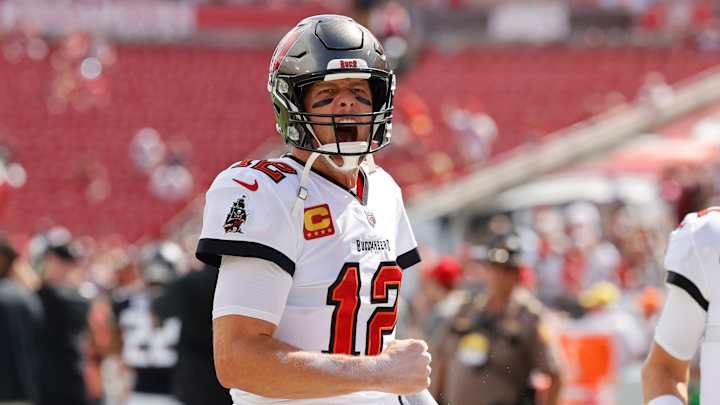
Tom Brady. Seven Super Bowl rings. Seven. The number is so absurd it almost doesn’t feel real.
Brady’s legacy isn’t just the rings — it’s how he got them. Five Super Bowl comebacks from fourth-quarter deficits. The 28-3 rally against Atlanta in Super Bowl LI — the greatest comeback in championship game history across any sport. The ability to perform his best in the biggest moments, decade after decade, with different coaches, different rosters, and different offensive systems.
No athlete in team sports history has a stronger case for GOAT status than Tom Brady. Not Jordan. Not Gretzky. Not Montana. Seven championships in ten appearances over 23 years of dominance. He redefined what was possible for a quarterback — and for an athlete’s career arc.
Joe Montana. 4-0 in Super Bowls. Zero interceptions in 122 Super Bowl pass attempts. Montana was clinical perfection when the stakes were highest. “The Drive” against Cincinnati in Super Bowl XXIII — 92 yards in the final three minutes, capped by a touchdown to John Taylor — is the most iconic championship-winning drive in NFL history.
Montana’s greatness was his composure. He never looked stressed. He never panicked. He operated in the biggest moments with the calm of a man ordering coffee. Four rings, zero Super Bowl losses, and a legacy of clutch performance that only Brady has surpassed.
Ben Roethlisberger. Two Super Bowl championships. The youngest quarterback to win a Super Bowl — at 23 years old. And the owner of one of the most improbable championship resumes in NFL history.
Here’s why Big Ben belongs on Mount Rushmore — and this is going to trigger people:
Roethlisberger never had a losing season as a starter. Think about that. In 18 seasons, his teams always finished above .500. He won with defense-first teams, run-first teams, and pass-first teams. He adapted to every roster construction and every coaching philosophy and still won.
His playoff resume includes some of the most physically punishing performances ever delivered by a quarterback. Big Ben played through injuries that would have sidelined lesser men. He extended plays with his 6’5”, 240-pound frame, shrugged off pass rushers, and delivered throws while being hit that no other quarterback could make.
Was he the most statistically dominant quarterback? No. Was he the most efficient? No. But the man won. Consistently, relentlessly, and in circumstances where more talented quarterbacks would have folded. Two rings, three Super Bowl appearances, and the most physically imposing quarterback presence the position has ever seen.
Terry Bradshaw (also in the Gunslinger room). Four rings in six years. Bradshaw’s championship run with the Steelers — 1974, 1975, 1978, 1979 — is the second-greatest dynasty in NFL history behind only Brady’s Patriots. He showed up in Super Bowls and delivered — 932 yards and 9 touchdowns across four championship games.
The Mount Rushmore of Quarterbacks
Four faces. Carved in stone. And at least one pick that’s going to start a fight.
Tom Brady. Seven rings. Ten Super Bowl appearances. The most accomplished athlete in team sports history. Brady is the first face on the mountain and there is no debate. He played the position longer, better, and more successfully than any human being who ever lived. First face. Non-negotiable.
Joe Montana. 4-0 in Super Bowls. The most perfect big-game quarterback ever. Montana’s flawlessness in championship moments — zero interceptions in four Super Bowls — represents the highest peak of quarterback performance under pressure. If Brady is volume, Montana is precision. Second face.
Peyton Manning. Five MVPs. The most intelligent quarterback who ever played. Manning changed how the position was played at the line of scrimmage — his pre-snap mastery influenced every quarterback who came after him. Two rings with two franchises. The most prolific statistical career in history at the time of his retirement. Third face.
Ben Roethlisberger. Two rings. Three Super Bowl appearances. Youngest quarterback to win the big game. Never had a losing season. Won with every type of roster around him. Big Ben was the most physically dominant quarterback ever — extending plays with his massive frame and delivering throws under duress that nobody else could make.
This is the pick that generates hate mail. Where’s Elway? Where’s Marino? Where’s Mahomes?
Elway went 2-5 in Super Bowls and got embarrassed in three of them. His two wins came with Terrell Davis carrying the offense. Marino never won a Super Bowl. Mahomes isn’t eligible yet — and when he is, he’ll likely claim a spot. But as of today, Big Ben’s combination of rings, durability, and relentless winning earns the fourth face.
Who just misses: John Elway’s five Super Bowl appearances and two rings make a strong case — but the three blowout losses and his reliance on the running game in his championship years cost him. Dan Marino’s arm talent was the greatest ever, but zero rings in a team sport matters. Patrick Mahomes will likely claim a spot when eligible — three rings and counting. Steve Young’s 1994 season was the most complete ever, but his body of work as a starter (only 8 full seasons) limits his candidacy.
The Hybrids
Tom Brady transcends every category — Field General, Game Manager, and Winner simultaneously. He evolved from a game manager in his early career to a field general in his prime to the ultimate winner across two decades.
Steve Young bridged Dual Threat and Field General — a scrambler with a pocket passer’s precision. He’s the template for every “complete” quarterback who followed.
John Elway was a Gunslinger who became a Game Manager — his early career was defined by arm talent and improvisation, his championship years by discipline and efficiency.
Patrick Mahomes is building a hybrid resume that spans Dual Threat, Gunslinger, and Winner — with the arm talent of Marino, the mobility of Young, and the ring collection of Brady. If he stays healthy, he may be uncategorizable.
Who’s Missing from Canton?
Patrick Mahomes. First ballot lock when eligible. Three Super Bowls, three MVPs, and the most dynamic quarterback play in NFL history. The only question is where he ranks all-time — and the answer depends on how many more rings he collects.
Eli Manning. The most divisive Canton candidate in history. Two Super Bowl MVPs — both against Brady’s Patriots — and a regular season career that was aggressively average. The argument for: no quarterback has more iconic championship moments against the greatest dynasty ever. The argument against: everything outside those two games.
Drew Brees. 80,358 passing yards. 571 touchdowns. One Super Bowl ring. Brees held virtually every volume passing record when he retired. His candidacy is strong — but the single ring and the stat-inflated New Orleans dome environment give voters pause.
Aaron Rodgers. The most efficient passer in NFL history by career passer rating. Four MVP awards. One Super Bowl ring. Rodgers’ arm talent — the ability to throw from any platform, any angle, any arm slot — may be the greatest ever. But the single championship in an era where quarterbacks are judged by rings limits his all-time case.
Philip Rivers (not in Canton). 63,440 yards, 421 touchdowns, zero Super Bowl appearances. Rivers was one of the best quarterbacks of his generation — but “very good for a very long time without winning the big one” is a tough Canton pitch.
Ben Roethlisberger (already on Mount Rushmore — but technically not yet inducted). When he’s eligible, the two rings and the never-had-a-losing-season record should make him a strong candidate. The off-field controversies may delay his induction but shouldn’t prevent it.
Russell Wilson. One Super Bowl ring, one Super Bowl loss on the goal line. Wilson’s prime — 2012-2020 in Seattle — was defined by clutch play, elite efficiency, and the ability to carry mediocre rosters. His post-Seattle decline complicates the candidacy.
Matt Ryan. MVP in 2016. 62,792 career yards. But the 28-3 Super Bowl collapse — and the lack of other deep playoff runs — will haunt his candidacy.
Future Entrants: Who’s Building a Canton Case?
Patrick Mahomes — Lock. First ballot. Potentially the GOAT when it’s all said and done.
Josh Allen — Needs a ring. The talent and physical tools are Canton-caliber, but the postseason resume isn’t there yet.
Lamar Jackson — Two MVPs. His dual-threat ability is historically unprecedented. Needs playoff success to build the full Canton case.
Joe Burrow — Elite talent, Super Bowl appearance, but injuries have robbed him of critical development time. If he stays healthy and wins a ring, the conversation opens.
Jalen Hurts — Super Bowl appearance, dual-threat ability, ascending trajectory. Early in the conversation but on a Canton-possible path.
The Quarterback Room: Final Roster
Walk into the Hall of Fame quarterback room and you’ll feel the weight of history.
The Field Generals command one wall — Manning, Brady, Fouts, Moon, Aikman. The chess masters who won with their minds before their arms.
The Gunslingers light up the opposite wall — Marino, Favre, Elway, Bradshaw, Warner, Namath. The risk-takers who made the impossible look routine and gave their coaches heart attacks in the process.
The Dual Threats fill the center — Young, Cunningham, Tarkenton, Staubach, and eventually Mahomes. The rule-breakers who forced the sport to evolve.
The Game Managers hold the quiet corner — Starr, Griese, Dawson, Kelly. The men who proved that winning doesn’t require heroics. Sometimes it just requires not losing.
And The Winners get the trophy case — Brady, Montana, Roethlisberger, Bradshaw. The men who played their best when it mattered most.
The quarterback room is the loudest room in Canton. Not because of the players in it — but because of the arguments about who belongs there, who deserves the top spot, and who got snubbed.
Those arguments will never end. And that’s exactly what makes the quarterback the greatest position in sports.
This was the last room. The series is complete. From running backs to wide receivers to tight ends to defensive linemen to quarterbacks — Canton’s best have been sorted, categorized, and debated.
Now it’s your turn. Who’d we get right? Who’d we get wrong? And who’s your Mount Rushmore?
The comments section is the real Hall of Fame debate. Enter at your own risk.
That’s the HOF Room series — all five positions complete. Who’s your QB Mount Rushmore? Is Big Ben over Elway justified? Where does Mahomes rank right now? The final debate starts in the comments.