
The Hall of Fame Wide Receiver Room: Sorting Canton's Pass Catchers by What Made Them Uncoverable

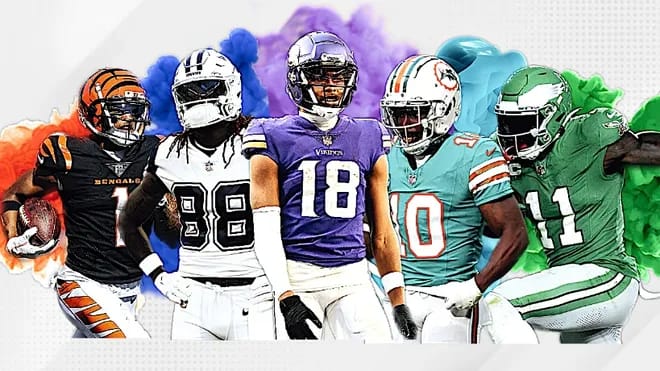
Part 2 of the Pro Football Hall of Fame Room Series
If Part 1 taught us anything — shoutout to the Cowboys fans still typing angry paragraphs about Emmitt Smith — it’s that sorting Hall of Famers by archetype hits different. The debates write themselves.
Now we’re stepping into the Wide Receiver Room. And if you thought the running back archetypes were spicy, wait until we start telling Larry Fitzgerald fans — fresh off his first-ballot induction LAST WEEK — that he didn’t make the Mount Rushmore.
The wide receiver position is the most diverse in football. Some guys won with speed. Some won with hands. Some won with routes so precise they looked choreographed. And some won because God decided to put a 6’5” man with 4.35 speed on this earth and let the rest of us deal with it.
Here are the five archetypes:
- The Route Technician — open by design, not by accident. Every route was a chess move.
- The Deep Threat / Vertical Menace — one play, six points. Take the top off the defense and change the game.
- The Possession Receiver — third down? Big moment? Give me the ball. Chain movers and security blankets.
- The YAC Monster — catch it short, turn it long. The most dangerous guys with the ball in their hands after the catch.
- The Physical Freak — size, speed, and athleticism that shouldn’t coexist in one human body. Won because they simply could not be covered.
But first — Mount Rushmore.
The Mount Rushmore of Hall of Fame Wide Receivers
Four faces. Carved in granite. Permanent. And yeah, we already know you’re going to have a problem with at least one of these.
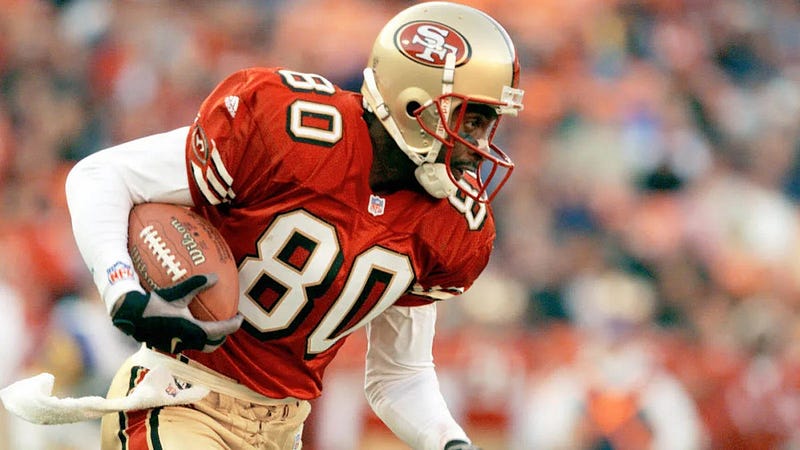
Jerry Rice — If Jim Brown was non-negotiable at running back, Rice is non-negotiable times ten. 22,895 receiving yards. 197 touchdown receptions. 1,549 catches. He held virtually every meaningful receiving record when he retired, and most of them still stand. Rice played 20 seasons and had 11 consecutive 1,000-yard campaigns. In 1987, he caught 22 touchdowns in 12 games — a strike-shortened season. Twelve games. Twenty-two touchdowns. The gap between Rice and everyone else at this position isn’t a gap. It’s a canyon. You don’t debate Jerry Rice. You just accept him.
Randy Moss — The most terrifying weapon the passing game has ever produced. Moss didn’t run routes — he ran past people. His rookie season in Minnesota — 69 catches, 1,313 yards, 17 touchdowns — announced that the league had a new problem it couldn’t solve. His 2007 season with Brady and the Patriots — 23 touchdowns, still the single-season record — proved he could do it in any system, with any quarterback, at any age. Moss had 156 career receiving touchdowns, second only to Rice. When people say “You got Mossed,” they’re describing something that happened to entire defensive game plans, not just cornerbacks.
Terrell Owens — Here come the pitchforks. TO over Larry Fitzgerald? Over Marvin Harrison? Yes. And here’s why. Owens retired with 15,934 receiving yards (third all-time) and 153 touchdowns (third all-time). He was a six-time Pro Bowler and a five-time First-Team All-Pro. But what separates TO isn’t just the stats — it’s the fearlessness. This is a man who played in Super Bowl XXXIX seven weeks after breaking his leg and tearing ankle ligaments. Nine catches, 122 yards, against the Patriots secondary. On a broken leg. Owens would go across the middle when other receivers wouldn’t. He blocked like a tight end. He bullied corners. The “diva” label overshadowed one of the five most talented players to ever line up at wide receiver. The Hall voters made him wait three years because of his personality. This list doesn’t penalize personality. It rewards dominance.
Calvin Johnson — And THIS is where it gets loud. Megatron played nine seasons. Nine. Larry Fitzgerald played seventeen. And we’re putting Calvin Johnson — who retired at 30, walked away from $16 million because the Lions were the Lions — on this mountain over Fitzgerald, who just got his gold jacket six days ago.
Here’s the case: Calvin Johnson’s peak was the highest peak any wide receiver not named Jerry Rice has ever reached. He set the single-season receiving record with 1,964 yards in 2012 — and he did it with Matthew Stafford, not Peyton Manning or Tom Brady. At 6’5”, 237 pounds, running a 4.35 forty, Johnson was a cheat code. Triple coverage didn’t matter. He’d go up and take it anyway. In his nine seasons, he averaged 86.1 receiving yards per game — higher than Rice’s career average (75.6), higher than Moss’s (62.0), higher than anyone’s. Megatron didn’t just play wide receiver. He played a different sport than everyone else on the field.
So where’s Larry Fitzgerald?
Right here in the conversation — just not on the mountain. And Cardinals fans, we get it. The man is second all-time in receptions (1,432) and receiving yards (17,492). Eleven Pro Bowls. One of the greatest postseason performers in history — his 2008 playoff run (30 catches, 546 yards, 7 touchdowns in four games) was otherworldly. Fitzgerald’s hands might be the best the position has ever seen.
But Rushmore isn’t the Hall of Fame. Fitzgerald was never the best receiver in football in any given season. He never led the league in receiving touchdowns. He had one First-Team All-Pro selection in seventeen years. He was remarkably consistent for an incredibly long time — but consistency isn’t transcendence.
Calvin Johnson was the best receiver in football for a five-year stretch despite playing on the worst franchise in professional sports. Fitzgerald had Kurt Warner for a cup of coffee and still couldn’t claim a season where he was inarguably the best in the game. Megatron’s nine years of dominance outweigh Fitzgerald’s seventeen years of excellence.
Larry Fitzgerald is a first-ballot Hall of Famer and a top-ten receiver of all time. But this mountain only has four spots. And peak matters more than longevity.
Cards fans, Colts fans, Vikings fans — the comments are open. Bring your Rushmore.
Now let’s sort the room.
The Route Technician Room
These receivers didn’t beat you with speed or size — they beat you with craft. Every route was a setup for the next one. Every stem had a purpose. Defensive backs knew what was coming and still couldn’t stop it.
Jerry Rice (San Francisco 49ers/Oakland Raiders/Seattle Seahawks, 1985–2004) Rice wasn’t the fastest. He ran a 4.71 forty at the combine — a number that would get a receiver laughed out of the building today. But no one in history ran routes like Rice. Every cut was razor-sharp. Every release was different. He set up DBs like a boxer sets up a knockout — jab, jab, jab, then the cross. Rice’s route running turned a 4.71 into 22,895 yards and 197 touchdowns. Speed fades. Precision doesn’t.
Raymond Berry (Baltimore Colts, 1955–1967) Berry basically invented modern route running. He studied film obsessively, practiced with Johnny Unitas until both of them could run routes in their sleep, and turned the short passing game into an art form. Berry caught 12 passes in the 1958 NFL Championship — the Greatest Game Ever Played. He wasn’t fast. He wasn’t big. He was just always open.
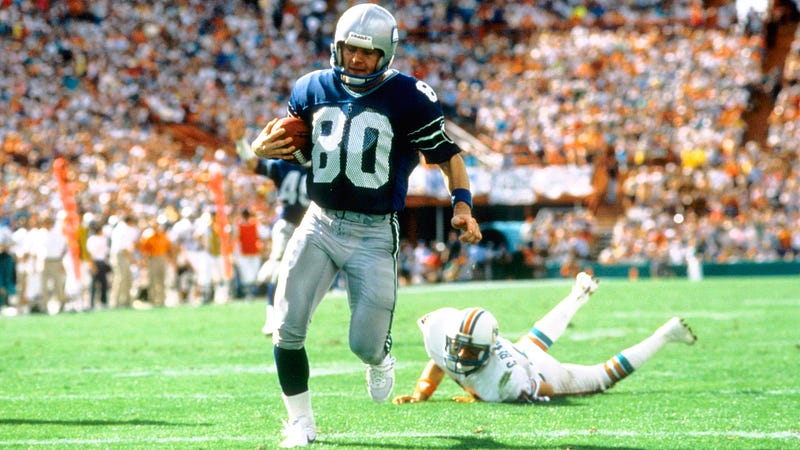
Steve Largent (Seattle Seahawks, 1976–1989) Largent retired holding every major receiving record — before Rice came along and shattered them all. At 5’11”, 187 pounds, Largent had no business being a Hall of Famer based on measurables. But his route-running precision and body control were elite. Eight 1,000-yard seasons in an era when defensive backs could mug you at the line. Largent proved that technique beats athleticism.
Fred Biletnikoff (Oakland Raiders, 1965–1978) Biletnikoff ran routes like a surgeon cuts — no wasted movement, every step deliberate. He was the Super Bowl XI MVP despite catching just 4 passes for 79 yards — because every single one of them moved the chains in a critical moment. Biletnikoff’s hands were legendary (stickum and all), but it was his ability to create separation without elite speed that defined his game.
Charlie Joiner (Houston Oilers/Cincinnati Bengals/San Diego Chargers, 1969–1986) Joiner retired as the NFL’s all-time leading receiver — before Rice rewrote the record books. He played 18 seasons and ran routes with a precision that made him a favorite of Don Coryell’s Air Coryell offense. Joiner was the thinking man’s receiver: always in the right place, always on time, never out of position.
The Deep Threat / Vertical Menace Room
One play. One mistake by the safety. Touchdown. These receivers changed the game by existing — their mere presence on the field forced defensive coordinators to adjust their entire scheme. You couldn’t single-cover them. You couldn’t ignore them. You could only hope they had an off day.

Randy Moss (Minnesota Vikings/Oakland Raiders/New England Patriots/Tennessee Titans/San Francisco 49ers, 1998–2012) The greatest deep threat in the history of professional football. Period. Moss’s combination of 6’4” height, 4.25 speed, and an absurd catch radius made him uncoverable down the field. His rookie season — 17 touchdowns — set the tone. His 2007 season — 23 touchdowns with Tom Brady — was the finishing blow. Moss didn’t just stretch the field. He broke it.
Bob Hayes (Dallas Cowboys/San Francisco 49ers, 1965–1975) Bullet Bob was an Olympic gold medalist (100m, 1964 Tokyo) before he ever caught an NFL pass. His speed was so game-breaking that NFL defenses literally invented the zone defense to deal with him. Think about that. One player’s speed changed defensive scheme philosophy for the entire league. Hayes forced the evolution of football. Nobody else on this list — or any list — can say that.
Lance Alworth (San Diego Chargers/Dallas Cowboys, 1962–1972) Bambi was the original deep threat. His 1965–66 stretch — averaging over 110 yards and one touchdown per game at 20+ yards per catch — might be the best back-to-back seasons any receiver has ever had relative to the era. Alworth was the first AFL player inducted into the Hall of Fame, and he earned it by making the deep ball an art form before anyone else knew what to call it.
Paul Warfield (Cleveland Browns/Miami Dolphins, 1964–1977) Warfield’s yards-per-catch average (20.1 for his career) tells you everything. He wasn’t a volume receiver — he was a damage-per-touch receiver. Every time Warfield caught the ball, something catastrophic happened to the defense. He was the deep weapon on the only undefeated team in NFL history (1972 Dolphins) and a two-time champion. Warfield didn’t need 100 catches. He needed one.
James Lofton (Green Bay Packers/Los Angeles Raiders/Buffalo Bills/Los Angeles Rams/Philadelphia Eagles, 1978–1993) Lofton played 16 seasons and accumulated 14,004 receiving yards — largely on the strength of elite deep speed that lasted well into his 30s. He was a track star at Stanford and brought that speed to the NFL for nearly two decades. Lofton was still stretching the field for the Bills in their Super Bowl runs at age 35.
Don Maynard (New York Giants/New York Titans-Jets, 1958–1973) Maynard was Joe Namath’s deep weapon on the Jets team that shocked the world in Super Bowl III. He retired as the NFL’s all-time leading receiver, and his downfield speed and route-running combination made him one of the most feared deep threats of his era. Maynard’s legacy is tied to Broadway Joe, but his talent stood on its own.
The Possession Receiver Room
Third and seven. Two minutes left. The game is on the line. Who do you throw to? These receivers built their legacies on reliability, body control, and the ability to make the catch that keeps the drive alive. They weren’t always the flashiest — but they were always there.

Larry Fitzgerald (Arizona Cardinals, 2004–2020) The best hands in NFL history. Fitzgerald’s catch radius, body control, and ability to make the difficult look routine made him the ultimate security blanket for a decade’s worth of Cardinals quarterbacks — most of whom didn’t deserve him. 1,432 career receptions, 17,492 yards, and a postseason run in 2008 that was as dominant as anything a receiver has ever done. Fitzgerald was the definition of “throw it up, Larry will come down with it.”
Cris Carter (Philadelphia Eagles/Minnesota Vikings/Miami Dolphins, 1987–2002) “All he does is catch touchdowns.” That quote, from fellow receiver Andre Reed, became Carter’s calling card. 130 career touchdown receptions — fourth all-time when he retired. Carter’s hands were absurd; he pioneered the toe-tap sideline catch that every receiver now tries to imitate. He didn’t beat you with speed or size. He beat you with hand-eye coordination that bordered on supernatural.
Art Monk (Washington Redskins/New York Jets/Philadelphia Eagles, 1980–1995) Monk was the first player in NFL history to catch 900 passes. He was the quiet, reliable, do-everything receiver on three Super Bowl-winning Washington teams. Monk never made a lot of noise — he just showed up every Sunday and caught everything thrown in his direction. His 940 career receptions were the all-time record when he retired.
Michael Irvin (Dallas Cowboys, 1988–1999) The Playmaker earned his nickname on third downs. Irvin was a possession receiver with attitude — a chain-mover who also happened to be one of the toughest competitors in the game. He was the go-to target on three Super Bowl championship teams and had five consecutive 1,000-yard seasons during the Cowboys’ dynasty years. Irvin caught everything in traffic and fought for extra yards like his life depended on it.
Andre Reed (Buffalo Bills/Washington Redskins, 1985–2000) Reed was Jim Kelly’s security blanket through four consecutive Super Bowl runs. His ability to find the soft spots in zone coverage and make tough catches over the middle defined Buffalo’s K-Gun offense. 951 career receptions and a legendary comeback performance against the Oilers in the 1992 Wild Card game — the greatest comeback in NFL history — where Reed caught 8 passes for 136 yards and 3 touchdowns after trailing 35–3.
Tommy McDonald (Philadelphia Eagles/Dallas Cowboys/Los Angeles Rams/Atlanta Falcons/Cleveland Browns, 1957–1968) McDonald was tiny — 5’9”, 175 pounds — and caught 84 career touchdowns playing without a facemask for most of his career. He was fearless over the middle, had reliable hands, and was one of the most productive receivers of the 1960s. McDonald waited decades for his Hall of Fame induction, but his production was undeniable.
The YAC Monster Room
Catch. Turn. Gone. YAC Monsters didn’t need 40-yard bombs to produce big plays. They created explosive gains after the catch — turning slants into touchdowns, screens into highlight reels, and short passes into broken defenses.

Terrell Owens (San Francisco 49ers/Philadelphia Eagles/Dallas Cowboys/Buffalo Bills/Cincinnati Bengals, 1996–2010) TO was a YAC monster disguised as a deep threat. At 6’1”, 224 pounds, Owens had the size to break tackles, the speed to outrun safeties, and the attitude to punish anyone who tried to bring him down in the open field. His yards-after-catch numbers were elite throughout his career because cornerbacks couldn’t tackle him and safeties couldn’t catch him. The Catch II against the Packers in the 1998 playoffs — a short pass that Owens turned into an 8-yard, game-winning touchdown while fighting through defenders — encapsulated everything about how he played.
Tim Brown (Los Angeles/Oakland Raiders, 1988–2004) Brown was the Raiders’ entire offense for the better part of a decade. His 1,094 career receptions and 14,934 receiving yards were built on an ability to turn short and intermediate passes into chunk plays. Brown’s quickness after the catch was exceptional — he’d catch a 5-yard out and turn it into 15 before anyone could react. Add in his return ability (3 career punt return touchdowns), and Brown was a YAC threat from anywhere on the field.
Bobby Mitchell (Cleveland Browns/Washington Redskins, 1958–1968) Mitchell was a halfback who became a wide receiver — and brought a running back’s elusiveness to the position. His ability to make defenders miss after the catch was revolutionary for the era. Mitchell was one of the most dynamic offensive weapons of the 1960s, and his transition from RB to WR made him a prototype for the modern yards-after-catch receiver.
Drew Pearson (Dallas Cowboys, 1973–1983) The original undrafted receiver, Pearson made his living turning short routes into big gains. His quickness and instincts after the catch made him Roger Staubach’s favorite target, and his ability to improvise in the open field led to some of the most iconic plays in Cowboys history — including the Hail Mary against the Vikings in the 1975 playoffs.
Sterling Sharpe (Green Bay Packers, 1988–1994) Sharpe’s career was cut tragically short — just seven seasons — by a neck injury. But in those seven years, he led the league in receptions three times and in receiving touchdowns twice. At 6’0”, 210 pounds, Sharpe was built to absorb contact and keep moving. His YAC ability was a key reason Brett Favre developed into a franchise quarterback. Many believe Sharpe would be in the conversation as a top-5 all-time receiver if his career had lasted even three more seasons.
The Physical Freak Room
These receivers didn’t win with one skill — they won because their bodies were built in a lab. Size, speed, leaping ability, and catch radius combined in ways that broke the sport. You couldn’t cover them because the human body wasn’t designed to match what they could do.

Calvin Johnson (Detroit Lions, 2007–2015) 6’5”. 237 pounds. 4.35 forty. 42.5-inch vertical. Megatron was a video game character playing in a real league. He set the single-season receiving record (1,964 yards in 2012) catching passes from Matthew Stafford behind a mediocre offensive line on a consistently bad team. Triple coverage was a suggestion, not a solution. Johnson retired at 30, walked away from $16 million because the Lions were the Lions — the same franchise that wasted Barry Sanders. Detroit’s greatest talent: producing generational players who’d rather retire than keep losing.
Harold Carmichael (Philadelphia Eagles/Dallas Cowboys, 1971–1984) At 6’8”, Carmichael was the tallest great receiver in NFL history. He used that height like a weapon — contested catches were his specialty because no defensive back could get high enough to contest them. Carmichael caught passes in 127 consecutive games, an NFL record at the time. He was a size mismatch decades before the term existed.
Elroy “Crazylegs” Hirsch (Chicago Rockets/Los Angeles Rams, 1946–1957) Hirsch earned his nickname because of his unorthodox running style — legs flailing in every direction, but somehow always moving forward. In 1951, he caught 17 touchdowns with a 22.7 yards-per-catch average — numbers that were absolutely absurd for the era. Hirsch’s combination of speed, size, and big-play ability made him one of the first true physical mismatch receivers.
John Stallworth (Pittsburgh Steelers, 1974–1987) Stallworth was 6’2” with long arms, excellent leaping ability, and the speed to run past coverage. He made some of the biggest catches in Super Bowl history — including a 73-yard touchdown in Super Bowl XIV that sealed the Steelers’ fourth championship. Stallworth’s athleticism was quiet but devastating; he didn’t talk about being a physical freak, he just played like one.
Isaac Bruce (Los Angeles/St. Louis Rams/San Francisco 49ers, 1994–2009) Bruce was the smooth operator of the Greatest Show on Turf. At 6’0”, 188 pounds, he wasn’t the biggest receiver, but his combination of speed, route-running, and leaping ability made him a matchup nightmare. His 73-yard touchdown catch in Super Bowl XXXIV — the play that sealed the Rams’ championship — showcased everything: speed, hands, and the athletic ability to turn a short pass into the biggest play of the season.
The Hybrids: Players Who Defy One Room

Jerry Rice — Listed as Route Technician, but his 22,895 yards and 197 touchdowns make a strong case for every room. Rice was the most complete receiver who ever lived. Period.
Terrell Owens — Listed as YAC Monster, but his deep-ball ability (Physical Freak), toughness over the middle (Possession), and contested-catch skills make him a three-room player.
Randy Moss — The purest Deep Threat ever, but his body control and leaping ability give him Physical Freak credentials too. Moss could high-point the ball like a 6’5” receiver because he basically was one.
Larry Fitzgerald — Possession Receiver primary, but his 2008 playoff run — averaging 136.5 yards per game with 7 touchdowns — was pure Physical Freak/Deep Threat energy. Fitzgerald had another gear he rarely needed.
Calvin Johnson — Physical Freak primary, but he could also win on routes (Route Technician) and was devastating after the catch (YAC Monster). Megatron was just unfair.
Michael Irvin — Possession Receiver who played with Physical Freak intensity. Irvin’s toughness and willingness to take hits over the middle was closer to a tight end than a wide receiver.
Who’s Missing? The HOF Wide Receiver Snubs
Torry Holt — Seven consecutive 1,000-yard seasons, six Pro Bowls, a Super Bowl ring with the Greatest Show on Turf. Holt has been a finalist multiple times and keeps getting passed over. His 13,382 career receiving yards are more than half the receivers already enshrined. The backlog at receiver is criminal. Archetype: Route Technician.
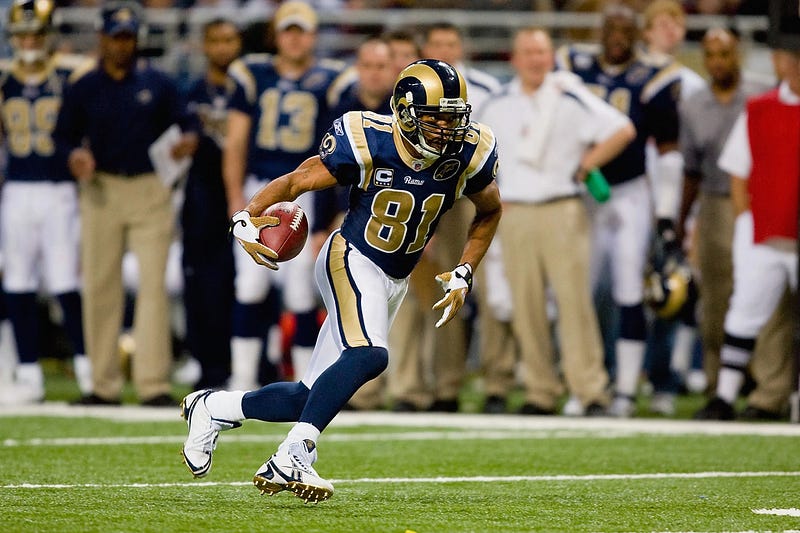
Reggie Wayne — 14,345 career receiving yards, six Pro Bowls, a Super Bowl ring with the Colts. Wayne was Peyton Manning’s most trusted weapon for a decade. His route-running precision and consistency deserve a gold jacket. Archetype: Route Technician/Possession.
Hines Ward — Super Bowl XL MVP, 1,000 career receptions, and the most punishing blocker to ever play wide receiver. Ward’s blocking was so elite that defensive backs actually feared him — not because he’d catch a pass on them, but because he’d crack-back block them into next week. Archetype: Swiss Army Knife (if we had one for WRs).
Andre Johnson — Five-time Pro Bowler and two-time receiving yards leader who spent his prime catching passes from a rotating door of mediocre Texans quarterbacks. Johnson’s talent was wasted by a bad franchise, but his peak (2008–2010) was as dominant as any receiver in football. Archetype: Physical Freak.
Anquan Boldin — 1,076 career receptions, a Super Bowl ring, and one of the toughest receivers in NFL history. Boldin wasn’t flashy, but he was the guy you wanted catching the ball when the game was on the line. Archetype: Possession/YAC Monster.
Future Entrants: The Next Gold Jackets
Julio Jones — 13,330 career receiving yards and a peak stretch (2014–2019) that rivaled anyone in the game. Jones was a Physical Freak who ran routes like a technician. His 2018 season — 113 catches, 1,677 yards — was masterful. Health and a quiet decline in Tennessee/later years might slow his candidacy, but the talent was generational. Archetype: Physical Freak.
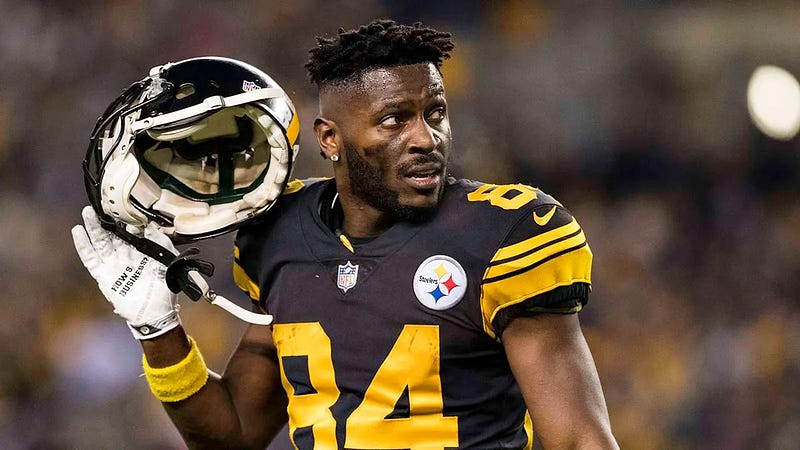
Antonio Brown — Here’s where it gets complicated. Brown’s on-field resume is a first-ballot case: 12,291 yards, seven consecutive seasons with 100+ catches, four First-Team All-Pro selections. He was arguably the best receiver in football from 2013 to 2018. But his off-field implosion — the Raiders meltdown, the sexual assault allegations, walking off the field mid-game in Tampa — will make voters uncomfortable. The talent is undeniable. The candidacy will be ugly. Archetype: Route Technician.
DeAndre Hopkins — 900+ receptions, five Pro Bowls, and some of the best hands in NFL history. Hopkins’ contested-catch ability is elite — he catches everything thrown within his zip code. His candidacy depends on how long he keeps playing at a high level. Archetype: Possession/Physical Freak.
Davante Adams — Six Pro Bowls, a 123-catch season, and one of the most precise route runners of his generation. Adams’ peak in Green Bay (2020–2021) was as dominant as any receiver not named Rice. He needs longevity to cement the case. Archetype: Route Technician.
Tyreek Hill — The Cheetah. The fastest player in the modern NFL with three First-Team All-Pro selections and a 1,710-yard season in Miami. Hill has redefined what a deep threat can be in the modern game. If he sustains this level, he’s Canton-bound. Archetype: Deep Threat/YAC Monster.
The Final Sort
Route Technician
Jerry Rice, Raymond Berry, Steve Largent, Fred Biletnikoff, Charlie Joiner
Deep Threat / Vertical Menace
Randy Moss, Bob Hayes, Lance Alworth, Paul Warfield, James Lofton, Don Maynard
Possession Receiver
Larry Fitzgerald, Cris Carter, Art Monk, Michael Irvin, Andre Reed, Tommy McDonald
YAC Monster
Terrell Owens, Tim Brown, Bobby Mitchell, Drew Pearson, Sterling Sharpe
Physical Freak
Calvin Johnson, Harold Carmichael, Elroy Hirsch, John Stallworth, Isaac Bruce
Agree? Disagree? Is Larry Fitzgerald getting disrespected on this Rushmore? Should Marvin Harrison be in over TO? Is Calvin Johnson’s nine-year career really enough for the mountain? And where’s your boy Megatron — Physical Freak or something else entirely? Drop your Rushmore and your room assignments in the comments. Cardinals fans — the floor is yours.
Next up in the Hall of Fame Room Series: The Tightend Room — where we ask whether the position has enough Hall of Famers to even fill a room, and sort the ones who are there by blocker, receiver, and hybrid.
Part 2 of 5 in the Pro Football Hall of Fame Room Series