
The Hall of Fame Tight End Room: Sorting Canton’s Best by What Made Them Unstoppable
The tight end position has evolved more than any other in football. From glorified linemen to matchup nightmares, here’s how Canton’s tight ends sort into the archetypes that defined the position — and who’s missing from the room.

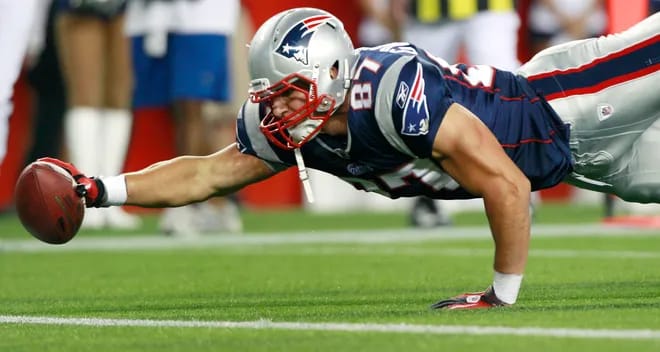
The tight end position has evolved more than any other in football. From glorified linemen to matchup nightmares, here’s how Canton’s tight ends sort into the archetypes that defined the position — and who’s missing from the room.
The tight end is football’s most schizophrenic position.
In the 1960s, a tight end was a sixth offensive lineman who occasionally leaked into the flat for a 7-yard catch. By the 2020s, the position had morphed into the most versatile weapon on the field — 6’5”, 250-pound athletes running routes that would make wide receivers jealous while still putting their hand in the dirt on run plays.
No position in football has undergone a more radical transformation. And the Hall of Fame tight end room reflects that evolution — a collection of players who, in some cases, were barely playing the same position.
Let’s sort them.
The Archetypes
The Complete Tight End — The unicorn. Elite blocker AND elite receiver. These guys did everything the position demanded at the highest level simultaneously. They didn’t have a weakness to scheme around — you just had to pick your poison and pray.
The Receiving Tight End — Pass-catching specialists who happened to line up at tight end. Average to poor blockers who were essentially big slot receivers. They changed the position’s ceiling offensively but often left their teams scrambling for blocking solutions on run plays.
The Blocking Tight End — The old school maulers. These guys moved defensive ends off the ball and created running lanes before tight ends were expected to run seam routes. They caught passes when the play called for it, but their legacy lives in the ground game.
The Red Zone Weapon — Some tight ends didn’t dominate between the 20s, but inside the 10-yard line? Unstoppable. Their combination of size, hands, and body positioning made them touchdown machines in the game’s most critical real estate.
The Matchup Nightmare — Too big for defensive backs. Too fast for linebackers. These were the tight ends who broke defensive coordinators’ brains. They didn’t just win their matchups — they created matchups that had no good answer.
Now let’s place Canton’s tight ends where they belong.
The Complete Tight End
This is the smallest and most exclusive room — because doing everything at an elite level is the hardest thing in football.
Rob Gronkowski. The gold standard. Gronk was a devastating blocker who pancaked defensive ends and a receiving threat who made safeties look like children. 521 receptions, 7,861 yards, 79 touchdowns in just 115 games — and those numbers are suppressed by injuries. His peak — 2011 to 2017 — is the most dominant stretch any tight end has ever produced. He blocked like a lineman and scored like a wide receiver, often on the same drive. There is no debate about Gronk’s completeness. He’s the prototype.
Mike Ditka. The original. Before Ditka, tight ends were blockers who occasionally caught passes. Ditka flipped the script — 56 receptions for 1,076 yards as a rookie in 1961. That was unheard of for the position. But what separates Ditka from the receiving specialists who came later is that he was also a punishing blocker. He played the position with a linebacker’s mentality and a receiver’s hands. He didn’t just change what tight ends could do offensively — he proved they didn’t have to sacrifice the blocking to do it. Every complete tight end that followed owes Ditka a royalty check.
George Kittle (not yet in Canton, but worth mentioning). The modern heir to Gronk’s throne. Kittle’s blocking is genuinely elite — he’s been graded as the best blocking tight end in football multiple seasons — while his YAC ability after the catch is freakish for a 250-pound man. When he’s eligible, he belongs in this room.
The Receiving Tight End
This is where the position’s evolution gets loud. These guys didn’t just catch passes — they demanded targets. They were the reason offensive coordinators started lining tight ends up in the slot, out wide, and even in the backfield.
Tony Gonzalez. The GOAT of receiving tight ends and arguably the greatest tight end ever, period. 1,325 receptions. 15,127 yards. 111 touchdowns. 14 Pro Bowls. He played 17 seasons and was a dominant force for nearly all of them. Gonzalez was a basketball player at Cal who brought that court vision and body control to the football field. He wasn’t the blocker that Gronk or Ditka were — but he redefined what the position could be as a pass catcher. Before Gonzalez, a 70-catch season from a tight end was exceptional. He made 90-catch seasons routine. Every receiving tight end playing today is running the blueprint Gonzalez drew.
Travis Kelce (not yet in Canton). Kelce took what Gonzalez built and added a gear. The first tight end with five consecutive 1,000-yard seasons. He surpassed Gonzalez’s records while playing alongside Patrick Mahomes in the most dominant offensive partnership of the era. Kelce’s route-running is wide receiver caliber — he wins with precision, not just size. His blocking was serviceable but never his calling card. He was a weapon, pure and simple, and the Chiefs built a dynasty around deploying him.
Shannon Sharpe. The first tight end to reach 10,000 receiving yards. Three Super Bowl rings. A loudmouth who backed up every word with production. Sharpe was electric with the ball in his hands and a nightmare in the middle of the field. But — and this is where it matters for the room — he was a poor blocker. He was essentially a wide receiver listed at tight end, a tweener who benefited from an era where the position was just beginning to split into specialists. His production is undeniable. His completeness as a tight end? That’s a different conversation. Sharpe is in the receiving room, not on Mount Rushmore.
Kellen Winslow Sr. The man who was ahead of his time by at least a decade. Winslow’s 1981 playoff performance against Miami — 13 catches, 166 yards, a blocked field goal, playing through injuries that would sideline modern players — is one of the greatest individual games in NFL history regardless of position. He was the first tight end to truly be used as a primary offensive weapon in the passing game. Injuries cut his career short, but the blueprint he laid for every receiving tight end that followed earns him a permanent spot in this room.
Ozzie Newsome. “The Wizard of Oz” was quietly one of the most consistent receivers of his era — 662 receptions over 13 seasons with the Browns. He didn’t have the peak dominance of Gonzalez or the highlight reel of Winslow, but his hands were immaculate and his route-running was silky for a man his size. Newsome proved a tight end could be a reliable, high-volume target week after week — he had a stretch of 150+ consecutive games with a reception. Understated greatness.
Dave Casper. “The Ghost” was a key weapon in the Raiders’ offense during their 1970s dynasty. Casper had soft hands, excellent body control, and a knack for making clutch catches — his “Ghost to the Post” reception in the 1977 playoffs is legendary. He was a better blocker than most receiving tight ends but his legacy is defined by his pass-catching ability in an era when tight ends weren’t expected to be primary targets.
The Blocking Tight End
The old guard. These men were linemen with eligibility — maulers who created running lanes and occasionally reminded everyone they could catch too.
Jackie Smith. 17 seasons with the Cardinals, 480 receptions — impressive numbers for any era, but Smith’s real value was his all-around game. He was a devastating blocker who could also stretch the field vertically, a rare combination in the 1960s and 70s. Unfortunately, his legacy is often reduced to a single dropped pass in Super Bowl XIII — one of the most famous drops in NFL history. That’s unfair to a career that defined what a well-rounded tight end looked like before the position fully specialized.
Charlie Sanders. A Detroit Lions legend who was one of the best blocking tight ends of the 1970s while also being a legitimate receiving threat — seven consecutive Pro Bowls. Sanders played in an era where tight ends were expected to be an extension of the offensive line first, and he excelled at it while still posting receiving numbers that were elite for his time.
The Red Zone Weapon
Some tight ends weren’t the most dynamic between the 20-yard lines. But once the field compressed inside the 10? They were automatic. Their combination of height, hands, and positioning made them the most reliable scoring threats on their teams.
Antonio Gates. 116 career touchdown receptions — the most by a tight end until Gronkowski approached his number. Gates was a basketball player at Kent State who never played college football, and that basketball background showed in the red zone. Contested catches, back-shoulder fades, box-out positioning — he scored touchdowns the way power forwards score in the post. He wasn’t an elite blocker and his between-the-20s production, while very good, wasn’t what defined him. What defined Gates was this: when the Chargers needed a touchdown, they threw it to Antonio Gates. And it worked. Over and over and over again.
Jimmy Graham (not yet in Canton). Another basketball convert who became a red zone terror. Graham’s peak with the Saints — particularly 2011 and 2013 — saw him function as essentially a 6’7” wide receiver who could high-point any ball thrown in his general direction. His blocking was a liability, which limited his overall value and may keep him out of Canton. But in the red zone, few tight ends in history were more effective.
The Matchup Nightmare
These are the tight ends who didn’t just win their individual battles — they created schematic problems that had no good answer. Put a linebacker on them? They’d run past him. Put a safety on them? They’d body him. Put a corner on them? They’d overpower him. Defensive coordinators lost sleep over these guys.
Tony Gonzalez (also in the Receiving room — he transcends categories). At 6’5”, 247 pounds with a basketball player’s agility, Gonzalez was the original matchup nightmare at tight end. Linebackers couldn’t cover him in space. Safeties couldn’t match his size at the catch point. He forced defenses to dedicate exotic coverages to a tight end — something that simply didn’t happen before him.
Rob Gronkowski (also in the Complete room). Gronk was the most extreme matchup problem in football history. At 6’6”, 265 pounds, he ran a 4.68 forty with hands like a receiver and a willingness to run through tacklers that bordered on sadistic. You could double him and he’d still catch it. You could bracket him and he’d still score. The only reliable coverage against Gronkowski was the injury report.
Kellen Winslow Sr. (also in the Receiving room). Before the term “matchup nightmare” existed, Winslow was living it. His size-speed combination was a decade ahead of the defensive personnel designed to cover tight ends. He was the first tight end who routinely made defenses wrong simply by being on the field.
The Mount Rushmore of Tight Ends
Four faces. Carved in stone. No debate.
Tony Gonzalez. The career. 1,325 receptions, 15,127 yards, 14 Pro Bowls, and the complete redefinition of what a tight end could be as a receiver. Gonzalez is the measuring stick for the position. Everyone who came after either chased his records or was compared to his standard. First face on the mountain, no discussion.
Rob Gronkowski. The peak. No tight end — and arguably no player at any position — has ever been as dominant as Gronkowski at his best. The combination of receiving and blocking at that level of dominance has never been replicated. Injuries limited his counting stats, but peak Gronk is the most unstoppable weapon the position has ever produced. Second face.
Mike Ditka. The pioneer. Before Ditka, the tight end position had a ceiling. He shattered it — as a rookie — and proved that tight ends could be dynamic offensive weapons without sacrificing their blocking responsibilities. Every complete tight end in history traces their lineage back to Iron Mike. Third face.
Kellen Winslow Sr. The revolutionary. Winslow took what Ditka started and pushed it into another dimension. His playoff performance against Miami is the single greatest tight end game ever played. He was the first tight end deployed as a true primary weapon, and his impact on how the position is used in the passing game is immeasurable. Injuries robbed us of what could have been an even more dominant career, but what he accomplished in his window was enough. Fourth face.
Who just misses: Travis Kelce will likely claim a spot when he’s eligible — his records and his role in the Chiefs dynasty make a compelling case. Antonio Gates’ touchdown record is historic. Shannon Sharpe’s production was elite. But the mountain only has four faces, and these four shaped the position itself.
The Hybrids
Some tight ends defy categorization — players who blended archetypes in ways that make them impossible to slot into a single room.
Rob Gronkowski is the ultimate hybrid — a Complete Tight End who was also the most terrifying Red Zone Weapon and Matchup Nightmare of his era. He lives in three rooms simultaneously and dominates all of them.
Tony Gonzalez bridges the Receiving and Matchup Nightmare rooms. He was the greatest pure pass-catcher at the position while also being one of the most difficult coverage assignments in football history.
Mike Ditka was a Blocking Tight End’s blocker with a Receiving Tight End’s production — a hybrid that didn’t exist before him and rarely existed after.
Who’s Missing from Canton?
The Hall of Fame tight end room has some notable absences — players whose careers demand consideration even if voters haven’t yet agreed.
Travis Kelce. This is a formality. When he’s eligible, he’s first ballot. The records, the rings, the cultural impact. Kelce will be on Mount Rushmore discussions for generations.
Jason Witten. 1,228 receptions — second all-time at the position behind Gonzalez. 13 Pro Bowls. The most reliable tight end of his generation. Witten wasn’t flashy, wasn’t fast, and wasn’t a highlight reel. He just got open. Every single play. For 17 years. The absence of a ring and the absence of a dominant peak may delay his induction, but the cumulative body of work is Hall-worthy.
Antonio Gates. 116 touchdown receptions and he never played college football. The basketball-to-football conversion that produced one of the most prolific scoring tight ends in history. Gates’ case suffers from playing on Chargers teams that never reached the Super Bowl, but individual production at the position is nearly unmatched.
George Kittle. Still active, still dominant. If Kittle maintains his current trajectory, his combination of elite blocking and explosive receiving makes him a strong candidate. He’s the most complete tight end since Gronkowski.
Dallas Clark. A stretch candidate, but Clark was the prototype for the modern move tight end — lining up everywhere, running routes that belonged in a receiver’s tree. His peak was short but influential.
Future Entrants: Who’s Building a Canton Case?
The next generation of tight ends is deep with talent. Here’s who’s on the Hall of Fame trajectory:
Travis Kelce — Lock. First ballot. Done.
George Kittle — Needs longevity, but the talent and completeness are Canton-caliber.
Mark Andrews — Elite red zone weapon with Lamar Jackson. Needs more sustained production and postseason success.
T.J. Hockenson — Young enough to build a case. Flashed All-Pro ability before injury. Needs a healthy, dominant second act.
Kyle Pitts — The highest-drafted tight end in NFL history (4th overall). The physical tools are generational. The production needs to match the pedigree.
Brock Bowers — The rookie sensation. Bowers broke receiving records as a rookie with the Raiders and has the highest ceiling of any young tight end in the league. If he sustains this trajectory for a decade, he’s a Canton conversation.
The Tight End Room: Final Roster
Walk into the Hall of Fame tight end room and here’s what you’ll find:
The Complete Tight Ends dominate one wall — Gronkowski and Ditka representing the pinnacle of doing everything at an elite level.
The Receiving Tight Ends fill the longest wall — Gonzalez, Sharpe, Winslow, Newsome, Casper, and eventually Kelce. This is where the position’s evolution is most visible, from Winslow’s pioneering to Kelce’s record-breaking.
The Blocking Tight Ends hold down the old-school corner — Smith and Sanders, reminders of what the position demanded before the passing revolution.
The Red Zone Weapons get a trophy case of touchdown balls — Gates eventually joining with his 116 scores.
And The Matchup Nightmares get a film room — because the best way to appreciate Gonzalez, Gronk, and Winslow is to watch defensive coordinators try and fail to stop them.
The tight end room isn’t the biggest in Canton. But it might be the most diverse — a position that evolved more dramatically than any other, represented by men who each pushed it forward in their own way.
From Ditka’s first 1,000-yard season in 1961 to Bowers breaking rookie records in 2024, the tight end has gone from football’s afterthought to its most versatile weapon.
And the room keeps getting better.
Who’s your Mount Rushmore of tight ends? Is Sharpe overrated? Is Witten getting robbed? Drop your rankings in the comments — the TE debate never ends. Next up D-Line.