300 Women in Pink Rallied for a Child Killer — And One Brought Her 4-Year-Old Daughter
They wore pink. They held signs that said “Believe” and “Peace for Lindsay.” They applauded her defense attorney. They said the Lord’s Prayer and made hearts with their hands. Then they went home to their own children — children who are alive because their mothers didn’t strangle them.

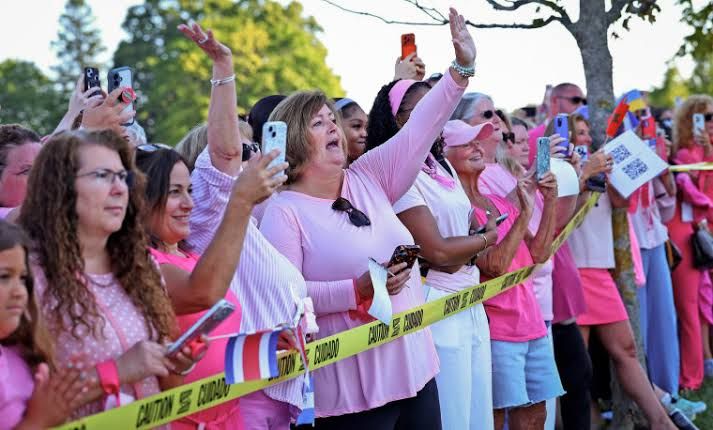
They wore pink. They held signs that said “Believe” and “Peace for Lindsay.” They applauded her defense attorney. They said the Lord’s Prayer and made hearts with their hands. Then they went home to their own children — children who are alive because their mothers didn’t strangle them.
On August 20, 2026, approximately 300 women gathered outside the Plymouth Superior Courthouse in Massachusetts. They wore pink shirts printed with messages: “Peace For Lindsay.” “Believe.” “She Needed Help.” “Justice For Lindsay.”
They weren’t rallying for the three dead children. They were rallying for the woman who killed them.
Lindsay Clancy strangled Cora, 5. Dawson, 3. And Callan, 8 months. She confessed. Her own defense attorney doesn’t dispute that she did it. The prosecution says she did it. She says she did it.
And 300 women drove to a courthouse, put on matching pink shirts, and stood for over an hour in solidarity with the woman who did it.
When defense attorney Kevin Reddington arrived at the courthouse, the crowd broke into applause. Rally organizer Renee Kimball told the crowd to trust that Reddington “has Lindsay’s fight.”
Lindsay’s fight. Not Cora’s fight. Not Dawson’s fight. Not Callan’s fight. Not Patrick Clancy’s fight — the father who came home to find all three of his children dead.
Lindsay’s fight. The confessed killer’s fight. That’s whose fight 300 women in pink showed up for.
Then they formed a circle, said the Lord’s Prayer, held up their arms, and made hearts with their hands.
Hearts. For a woman who used exercise bands to strangle the hearts out of three children who trusted her completely.
She Brought Her Daughter
Among the 300 women in pink was Kara Hurston. She brought her 4-year-old daughter, Prinn.
Let that settle for a moment.
A mother brought her 4-year-old child to a public demonstration supporting a woman who murdered a 5-year-old, a 3-year-old, and an 8-month-old.
Prinn is 4. Cora was 5. One year apart. If Cora were alive, they could be in the same preschool class. They could be friends. They could be playing together right now.
Instead, Cora is in a grave. And Prinn is at a rally supporting the woman who put her there — held on her mother’s hip, too young to understand the obscenity of her presence at this event.
What does a mother think as she drives her living 4-year-old to a rally for a woman who strangled her 5-year-old? What mental framework permits this? What ideology is so powerful that it overrides the most basic maternal instinct — the instinct to recoil in horror from a child killer rather than rally for her?
Kara Hurston’s presence at that rally — with her daughter — is the single most disturbing image to emerge from the Lindsay Clancy case. Not because of what it says about Kara Hurston specifically. But because of what it says about the cultural moment that produced her.
A culture so committed to the female victim narrative that a mother will bring her living child to support a woman who killed hers. And see nothing wrong with it.
What They Said
The women at the rally spoke to reporters. Their words deserve examination — not because they’re persuasive, but because they reveal the psychological framework driving this movement.
“Women are being dismissed, neglected and ignored when we speak up.” This was April Vincent, a 52-year-old paralegal from Providence, Rhode Island. She traveled from another state to support a confessed child killer — and framed it as a women’s rights issue.
Read her statement again. “Women are being dismissed when we speak up.” The woman she’s rallying for didn’t “speak up.” She strangled three children. The reframing — from “she killed her kids” to “women aren’t being heard” — is so aggressive it would be impressive if it weren’t covering for a triple homicide.
“This could have been any of us.” Multiple women at the rally said variations of this. The statement is meant to universalize Clancy’s experience — to position her not as a murderer but as a everywoman who fell through the cracks.
But here’s the math: roughly 600,000 women experience postpartum depression in the United States every year. The overwhelming majority of them — 599,997 out of 600,000 — do not kill their children. “This could have been any of us” is statistically false. It could NOT have been any of them. It was one woman. One woman who made choices that resulted in three dead children. Universalizing her crime insults every mother who suffered through PPD without harming her kids.
“I hope Lindsay gets the care she needs and deserves.” Lindsay Clancy strangled a 5-year-old, a 3-year-old, and an 8-month-old. The care she “needs and deserves” — according to the legal system she confessed to — is a prison cell. The fact that this statement was made without irony, at a rally, in pink, tells you everything about the moral framework operating here.
They held flags from different countries. According to reports, some supporters held international flags “to show that the support for Clancy was global.” Global support. For a child killer. Across borders. The sisterhood has gone international — and its mission now includes rallying for women who murder their own children.
Who Wasn’t at the Rally
Patrick Clancy wasn’t there. The man who lost three children in one evening — who came home to find them strangled by the woman he trusted with their lives — didn’t have 300 people in matching shirts showing up for him.
No “Peace for Patrick” shirts. No pink rally for the father. No organized demonstration for the man whose life was destroyed by the woman these people are applauding.
The children’s memory wasn’t represented. No signs for Cora. No signs for Dawson. No signs for Callan. In a rally of 300 people, ostensibly gathered because of a crime that killed three children, the children themselves were invisible. Their names weren’t on the shirts. Their photos weren’t on the signs. Their existence was erased from an event that only exists because they were murdered.
The rally was for Lindsay. Period. The children — the actual victims — were an inconvenience to the narrative. Mentioning them would have complicated the “she needed help” framing with the uncomfortable reality of what happened when she didn’t get it.
Fathers weren’t welcome. A few men attended, according to reports. But the rally was organized by women, attended by women, and framed as a women’s issue. The gendering of the response is deliberate — by making the Clancy case about women’s mental health rather than child murder, the organizers ensured that the conversation stays in a domain they control.
If the rally were framed as “justice for the children,” men would show up. Fathers would show up. And the conversation would shift from “she needed help” to “she killed three kids.” The gendered framing prevents that shift — which is exactly its purpose.
The Applause for the Defense Attorney
When Kevin Reddington — Clancy’s defense attorney — arrived at the courthouse, the crowd of 300 women broke into applause.
They applauded the man whose job is to prevent a confessed child killer from facing the full consequences of her actions.
In any other context, this would be unremarkable. Defense attorneys serve a vital constitutional function. Everyone deserves legal representation. The right to a defense is foundational to the justice system.
But the applause wasn’t for the constitutional principle. It was for the outcome the attorney is pursuing — the acquittal of a woman who strangled three children. The crowd wasn’t applauding due process. They were applauding the possibility that Lindsay Clancy might not go to prison for murdering her kids.
Imagine 300 men in matching shirts applauding the defense attorney of a father who strangled his three children. Imagine them holding signs that said “Peace for Dad” and “He Needed Help.” Imagine them bringing their sons to the rally and saying the Lord’s Prayer in a circle.
It wouldn’t happen. Not 300 people. Not 30. Not 3. A man who killed three children would have zero public support. His defense attorney would walk into the courthouse past hostile crowds, not cheering ones.
The applause for Reddington isn’t about legal rights. It’s about gender. And the gender determines whether you get condemnation or a standing ovation.
The Lord’s Prayer
They said the Lord’s Prayer at the end of the rally.
“Forgive us our trespasses, as we forgive those who trespass against us.”
The trespass they’re forgiving is the murder of three children. The forgiveness they’re extending is for a woman who strangled a 5-year-old, a 3-year-old, and an infant with exercise bands.
Using the Lord’s Prayer as a benediction for a child killer’s support rally is a perversion of faith so complete that it deserves its own article. The same prayer that asks for deliverance from evil was recited in solidarity with a woman who perpetrated evil on the three most innocent, most vulnerable, most defenseless humans imaginable — her own children.
If God has a position on this case, it’s not with the woman in the defendant’s chair. It’s with the three children who were delivered into evil by the hands that were supposed to deliver them from it.
What This Rally Tells Us
The pink rally isn’t about mental health. It’s not about maternal care. It’s not about the healthcare system. It’s about one thing:
The absolute, unconditional, unlimited commitment of the modern sisterhood to defending women regardless of what they’ve done.
The sisterhood absorbed infidelity. It absorbed manipulation. It absorbed roster culture. It absorbed the accountability exemption across every domain of female behavior. And now — with the pink rally for Lindsay Clancy — it has absorbed child murder.
There is no crime a woman can commit that will cause the sisterhood to withdraw its protection. There is no act so heinous that the female defense mechanism won’t activate to deflect, excuse, and rationalize. There is no line.
If 300 women will rally in pink for a woman who strangled three children, the line doesn’t exist.
And the culture that watches 300 mothers support a child killer — while bringing their own children to the demonstration — and doesn’t recoil in collective horror, is a culture that has lost something it may never recover.
Cora was 5. Dawson was 3. Callan was 8 months.
They don’t have a rally. They don’t have pink shirts. They don’t have 300 people forming hearts with their hands.
They have graves. And the woman who put them there has a fan club.
Should women be rallying for Lindsay Clancy? What does this say about accountability? Comments are open — and the children deserve to be remembered in this conversation.